By – Mafa Kwanisai Mafa
AUTHOR BIO:
Mafa Kwanisai Mafa is a Zimbabwean Pan-Africanist scholar, writer, and internationalist whose work focuses on decoloniality, anti-imperialism, and Global South solidarity. His writings critically examine contemporary geopolitical issues, African liberation, and the struggle for a just and multipolar world order. He is actively involved in solidarity initiatives with progressive movements and peoples across the Global South, promoting Pan-African unity, international cooperation, and the advancement of anti-colonial and emancipatory struggles.
ARTICLE:
The debate at the United Nations over the United States embargo against Cuba is no longer simply about trade or diplomacy. It is about whether a sovereign nation has the right to determine its own destiny without being subjected to relentless economic pressure. It is about whether international law should be respected or selectively ignored. Above all, it is about the everyday lives of millions of ordinary Cubans who continue to bear the human cost of a policy that has endured for decades.
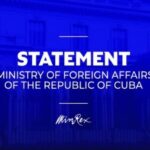
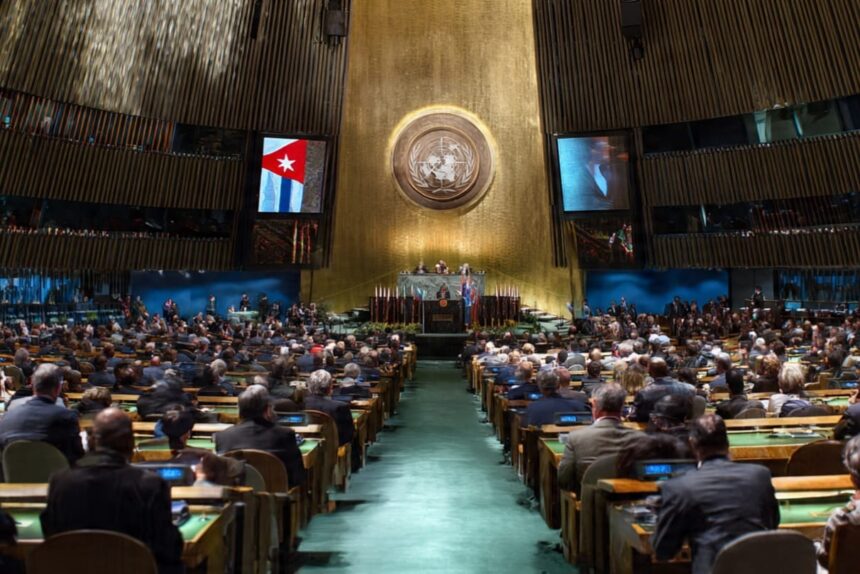
During the recent United Nations debate, Cuban Foreign Minister Bruno Rodríguez Parrilla delivered an impassioned defence of his country’s sovereignty, arguing that the embargo is not an abstract foreign policy instrument but a system whose consequences reach hospitals, schools, homes, and workplaces.
For many in the Global South, especially in Africa, Cuba’s struggle resonates beyond the Caribbean. It echoes a familiar history of colonial domination, economic coercion, and the persistent efforts by powerful states to dictate the political and economic choices of weaker nations. Africans understand that independence is not complete if external powers retain the ability to determine a country’s future through sanctions, financial isolation, or economic warfare.
Supporters of the embargo often present it as a tool to encourage political change. Cuba argues that the policy has instead become collective punishment, harming ordinary families far more than political leaders. Blackouts, shortages of medicine, interruptions in fuel supplies, and difficulties in maintaining essential public services are cited by Havana as direct consequences of increasingly restrictive sanctions.
Whether one agrees with every aspect of the Cuban political system is not the central issue before the international community. Nations have different political traditions, constitutional arrangements, and development paths. The principle at stake is whether one country should possess the unilateral authority to economically suffocate another in pursuit of political objectives.
This is precisely why the overwhelming majority of United Nations member states have repeatedly voted in favour of ending the embargo. Year after year, the international community has spoken with remarkable consistency. The continued isolation of Cuba on this issue is not Havana standing against the world; rather, it is the embargo itself that finds little international support.
For Africa, Cuba occupies a unique place in history. Cuban internationalist missions supported liberation struggles at moments when many powerful governments either remained silent or actively supported colonial and apartheid regimes. Cuban doctors continue to serve in remote communities across Africa, Latin America, Asia, and the Pacific, often where healthcare professionals are in critically short supply. These acts of solidarity have shaped how many developing nations view Cuba not simply as another state, but as a partner that has repeatedly shared its limited resources despite facing considerable economic hardship.
Critics may question aspects of Cuba’s domestic governance, and such debates are legitimate. Every country should continually strive to improve the lives and freedoms of its citizens. Yet those discussions should belong primarily to the Cuban people themselves. Political reform imposed through economic deprivation is unlikely to produce justice or stability. History shows that societies evolve most sustainably when change emerges through dialogue, participation, and national ownership rather than external coercion.
The embargo has also become a broader test of the credibility of international institutions. If nearly every member of the United Nations consistently rejects a policy, yet that policy continues unchanged, difficult questions arise about the effectiveness of multilateral diplomacy and the equal application of international norms.
The Cuban government argues that recent measures affecting fuel supplies amount to an intensified economic siege with profound humanitarian consequences. These claims deserve careful international attention, particularly where they concern access to electricity, healthcare, food security, and other essential services. Whatever political disagreements exist, civilians should never become collateral damage in geopolitical disputes.
The debate also highlights a larger global trend. Around the world, sanctions have increasingly become instruments of foreign policy. While governments often justify them as targeted measures, their indirect effects frequently extend to ordinary citizens through higher prices, shortages, disrupted infrastructure, and weakened public services. This reality deserves honest reflection from the international community.
From an African perspective, the lesson is clear. Sovereignty cannot be defended selectively. If smaller nations are expected to respect international law, larger powers must be held to the same standard. Equality among states cannot exist only in principle while power determines whose sovereignty deserves protection.
The Cuban people have demonstrated extraordinary resilience through decades of adversity. Their determination to preserve national independence, despite immense external pressure, reflects a broader aspiration shared across much of the developing world: the desire to shape one’s future free from domination. That resilience does not erase the hardships people endure, but it explains why many Cubans continue to frame their struggle in terms of dignity and self-determination.
Ultimately, the question before the world is not whether every observer agrees with Cuba’s political system. The deeper question is whether disputes between nations should be resolved through dialogue and diplomacy or through prolonged economic isolation.
The international community should continue to encourage constructive engagement, respect for sovereignty, and adherence to international law. Lasting progress will come not from policies that deepen hardship but from cooperation that creates space for development, dialogue, and mutual respect.
History has repeatedly shown that nations rarely abandon deeply held convictions under pressure alone. They respond more positively to engagement than to isolation. For Cuba, as for every sovereign nation, the future should be determined by its own people—not by external economic coercion. That principle is larger than any single country. It is a principle that speaks to the very foundation of an international order based on sovereign equality, peaceful coexistence, and respect for the independence of all nations.