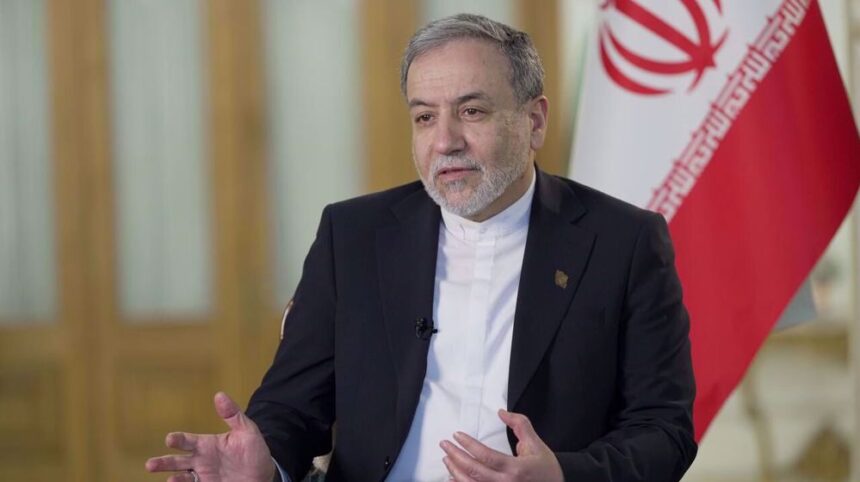
Iran’s Foreign Minister Abbas Araghchi has reiterated that the most significant obstacle in Tehran-Washington discussions is the United States’ refusal to recognize Iran’s internationally protected right to peaceful nuclear technology. Speaking to Japan’s Kyodo News Agency, Araghchi stressed that Iran will continue its nuclear activities despite sustained U.S. and Israeli pressure, including recent attacks targeting Iranian nuclear facilities.
Araghchi said the disagreement is not about technical procedures but a fundamental political stance taken by Washington. According to him, Iran’s right to enrich uranium for peaceful purposes is enshrined in international law, and Tehran will not abandon this principle under any form of pressure.
“The central issue is that the United States must accept Iran’s legitimate right to the peaceful use of nuclear technology, including uranium enrichment. This is not a new demand; it is a right recognized under global treaties and remains non-negotiable,” he said.
The foreign minister noted that Iran is a longstanding and fully compliant member of the Non-Proliferation Treaty (NPT), which grants signatory states the right to civilian nuclear research, energy production, and enrichment under IAEA supervision. He drew a comparison with Japan, another NPT member that conducts enrichment activities for peaceful purposes.
Meanwhile, Washington insists Iran halt all enrichment as a prerequisite for progress. President Donald Trump has demanded that Tehran end uranium enrichment altogether — a position Iranian officials view as unrealistic and contrary to the framework of the NPT.
Araghchi emphasized that negotiations with the United States cannot move forward unless Washington demonstrates a genuine shift in attitude. “If the U.S. government changes its approach and accepts the need for a balanced, mutually respectful negotiation, Iran will be ready. But negotiation is not the same thing as issuing orders. At this point, we do not see signs that Washington is serious,” he stated.
He argued that Iran’s skepticism is rooted in past experience, particularly the U.S. withdrawal from the 2015 nuclear agreement — known as the JCPOA — despite Iran’s verified compliance. He also pointed to the breakdown of the 2025 negotiation attempt. According to Araghchi, those talks were derailed after attacks on Iranian nuclear sites, widely attributed to Israel and carried out with what Iran describes as overt U.S. support.
“These events show that the United States is not currently prepared for reciprocal or credible negotiations,” he said, warning that trust cannot be rebuilt unless Washington proves it is willing to honor commitments.
Araghchi maintained that Iran will continue its nuclear program strictly within peaceful boundaries but will not accept conditions that undermine its sovereign rights. He added that Tehran remains open to diplomatic engagement with all countries, including Japan, which has traditionally played a mediating role in U.S.–Iran tensions.
As the standoff continues, analysts note that the unresolved dispute over enrichment rights remains the primary barrier preventing any diplomatic breakthrough — a deadlock that could shape regional dynamics for years to come.