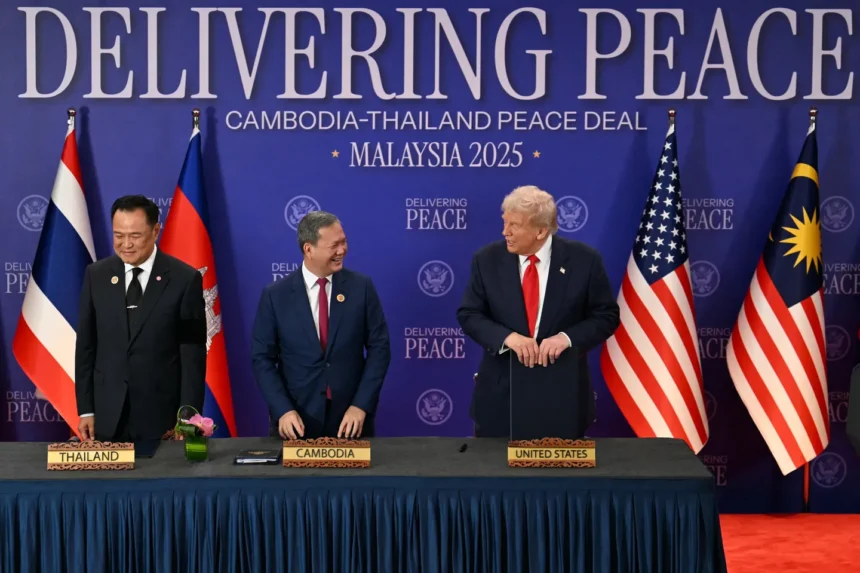
President Donald Trump has said he is prepared to personally intervene to ease rising tensions along the Thailand–Cambodia border, stating that he would “make a phone call” to help halt the escalating clashes that have displaced tens of thousands of civilians over the past week. His comments came during an informal briefing with reporters, where he expressed concern over the widening hostilities between the two Southeast Asian neighbors.
The conflict, triggered by long-standing territorial disputes, intensified after Thai and Cambodian troops exchanged artillery and drone fire across heavily contested border zones. Both sides have deployed reinforcements, prompting fears of a broader military confrontation reminiscent of the deadly 2008-2011 clashes near the ancient Preah Vihear Temple.
Trump said the situation could “spiral very quickly” if not contained and that the United States has a responsibility to encourage dialogue between regional partners. Although Washington has not taken sides, U.S. officials have expressed alarm over the humanitarian toll as more than half a million civilians have been forced into makeshift shelters.
Trump indicated that his approach would focus on direct leader-to-leader communication. “Sometimes a single phone call can stop things from getting worse,” he said. “Both sides know the United States wants peace.”
Diplomatic sources say Washington is considering appointing a temporary envoy to coordinate de-escalation talks. Analysts believe Trump’s personal involvement could carry symbolic weight, especially given his reputation for high-profile mediation efforts.
Thailand has signaled openness to third-party facilitation, though it insists that any negotiation must respect its territorial claims. Cambodian officials, meanwhile, accuse Thailand of violating established ceasefire lines and targeting civilian areas—allegations Bangkok denies.
Regional bodies, including ASEAN, have called for restraint but have struggled to convene emergency talks. Internal divisions within ASEAN, coupled with its tradition of non-interference, have limited its ability to respond swiftly.
Experts warn that without intervention, the conflict risks drawing in external actors or destabilizing border trade routes vital to both economies. The clashes have already disrupted rice and manufacturing supply chains, affecting broader Southeast Asian markets.
Trump’s offer comes at a time when the U.S. is looking to reinforce diplomatic influence in Asia amid growing competition with China. Some analysts view this as an opportunity for Washington to reassert itself as a stabilizing force in the region.
Whether Trump’s phone-call diplomacy will halt the fighting remains uncertain. However, his willingness to intervene signals rising international pressure on both countries to avoid further escalation.